Centre for Youth Policy
Konrad-Adenauer-Stiftung
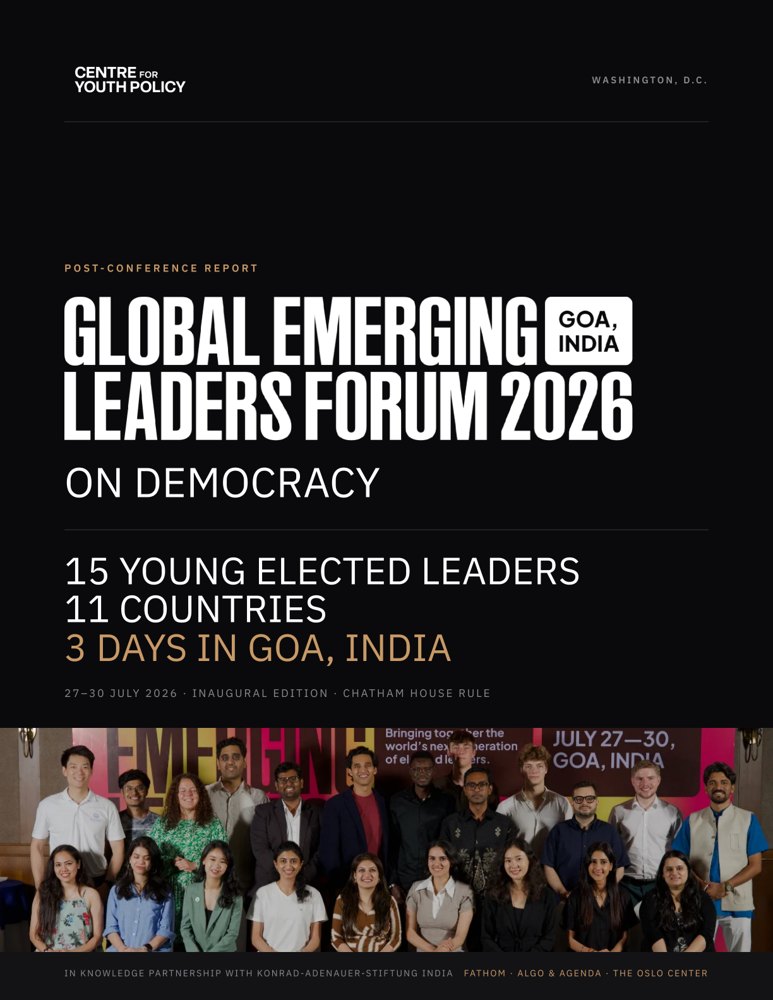
July 27–30, 2026 · Goa, India
Centre for Youth Policy · Inaugural Edition · 2026

Global Emerging
Leaders Forum

A closed-door retreat for the next generation of democratic leaders — young elected officials, party leaders, and members of government — not a conference to learn from us, but an investment in them.

30Young Leaders
20+Countries
3Days
Goa, IndiaInaugural Host

A Different Kind of Conversation

Across democracies, there is no shortage of conferences about democracy. What is missing is a space built around the people already exercising democratic power — young elected officials, political party leaders, and members of government from across the world — not to teach them, but to invest in them, off the record, and speak candidly about what they are experiencing.

The Global Emerging Leaders Forum on Democracy is that space. It is a small, curated, three-day retreat — designed not for speeches or panels, but for the kind of peer exchange, personal development, and long-term investment that the next generation of democratic leaders rarely receives.

The forum is exclusively for those already in positions of responsibility — elected representatives, party officials, and government leaders from across democratic systems — roughly half from South and Southeast Asia, half from other democracies. Perspectives from Germany are brought in via our partnership with Konrad-Adenauer-Stiftung India. The inaugural edition is hosted in Goa, India, with future editions planned across regions.

By invitation Off the record Dialogue-first Cross-border Non-partisan Global South Annual Forum

"The people already in the room — elected officials, party leaders, members of government — rarely get the kind of investment in their own growth that their positions demand. That is what this forum exists to provide."

— Forum Rationale

Democracy is not just under pressure in one country. The next generation of democratic leaders deserves a space to think about that — together, across borders.

— Centre for Youth Policy, Global Emerging Leaders Forum

Youth and Democracy Conference — participants in session

Democracy is not inheriting itself.

The average age of a head of government globally is over 60. In most national legislatures, politicians under 40 are a minority — and those under 30 are vanishingly rare. The median age of a parliamentarian is typically more than twice the median age of the population they represent.

This is not simply a symbolic problem. It shapes which issues get prioritised, which time horizons policymakers plan for, and whose lived experience is treated as politically legible. When climate policy, housing affordability, and the governance of technologies that older leaders do not use are decided by bodies from which young people are structurally absent, the representational deficit has real policy consequences.

"When young people in power are connected to one another and to the best available research on what works, they become meaningfully more effective — and the case for electing more of them becomes meaningfully stronger."

At the same time, young people are neither passive nor disengaged. The uprisings in Bangladesh, Nepal, Thailand, Chile, and across sub-Saharan Africa have demonstrated that generational frustration is politically volatile. The question is not whether young people will shape political outcomes — they will. The question is whether democratic institutions will adapt to channel that energy into durable representation, or whether it will cycle endlessly between protest and disillusionment.

The Global Emerging Leaders Forum on Democracy exists because the answer to that question depends, in significant part, on whether the next generation of democratic leaders know each other — across borders, across party lines, and across the divide between those inside formal institutions and those pushing from outside them.

60+
Average age of world leaders
The global median age of a head of government — in a world where half the population is under 30.
The representation gap
The median parliamentarian is typically twice the median age of the citizens they represent.
16
Heads of government under 35
Out of 193 UN member states — tracked by CYP's Global Youth Tracker across 220 countries.
Presenting research on youth political representation
Youth & Democracy Conference 2026 · India
From Our Work

What This Looks Like in Practice

The forum grows out of CYP's existing convening work — including the annual Youth & Democracy Conference, which has brought together young leaders, scholars, and practitioners from across the democratic world.

Group photo — Youth and Democracy Conference 2026 Participant in discussion Participants listening Fireside conversation Cross-border dialogue
Panel on stage Participant speaking Full conference room Presenting research International dialogue
Youth & Democracy Conference 2026 · Marwadi University, India · Co-hosted with Konrad-Adenauer-Stiftung
Participants

Who Is in the Room

The forum brings together 30–35 young leaders who are already in positions of democratic responsibility — elected representatives, political party officials, and members of government from across the world. This is not a forum for aspiring leaders or activists. Selected for the significance of their current role, their democratic commitment, and diversity of country, background, and profession. No two people should come from the same silo.

🏛️
Elected Representatives
Young parliamentarians, legislators, mayors, and municipal leaders from democracies around the world — navigating the daily reality of democratic politics from the inside.
Parliamentarians · Legislators · Mayors · Local Officials
🎯
Political Party Leaders
Young leaders within political parties — secretaries-general, youth wing leaders, and rising figures in parliamentary groups — who shape how parties develop, campaign, and govern.
Party Officials · Youth Wing Leaders · Political Strategists · Parliamentary Group Leaders
⚖️
Government Officials
Young ministers, deputy ministers, senior advisers, and officials working inside governments — shaping policy from positions of real institutional responsibility.
Junior Ministers · Government Advisers · Senior Officials · Parliamentary Secretaries
A First Look

Who's Coming

Young elected officials and public leaders from more than 20 countries. A first glimpse of the 2026 cohort, with more to be announced.

Modesta Petrauskaite — Member of Parliament, Lithuania Anushka Shreshta — Member of Parliament, Nepal, and former Miss Nepal Tsenguun Saruulsaikhan — Member of Parliament, Mongolia Fidias Panayiotou — Member of the European Parliament, Cyprus

Confirmed delegates include the Leader of the Opposition of Malta, the Minister of Youth and Law in Bihar, and young parliamentarians and public leaders from Mongolia, The Gambia, Bulgaria, Lithuania, Nepal, Moldova, Taiwan, Thailand, Germany, Cambodia, Armenia, and India.

Discussion Themes

What We Talk About

Each session is built around a question that young democratic leaders are wrestling with right now — not abstract theory, but the live challenges of practising democracy in 2026, across very different systems and contexts.

01
Pathways to Political Leadership
What does it actually take to enter and sustain a democratic political career — in a new democracy, an established one, or a fragile one? What barriers do young leaders share across very different systems?
02
Youth, Trust & Legitimacy
Why are young people disengaging from formal political participation across democratic systems — and what would it take to rebuild trust between citizens and their institutions?
03
Technology, Media & Democracy
How is digital communication reshaping democratic discourse globally — and what does disinformation, AI-generated content, and algorithmic politics mean for electoral integrity?
04
Institutions Under Pressure
How do democratic institutions hold up under strain across different systems? What does accountability look like — and what can leaders in one democracy learn from those in another?
05
India & the Democratic World
What can emerging leaders from the Global South, Europe, and beyond learn from each other — and how do we build lasting democratic solidarity across borders?
06
What Leadership Looks Like Now
What does democratic leadership mean for a generation that will shape governance across multiple countries over the next three decades?
How It Works

The Format

Three days. No lecterns. No speeches. Thirty people from across the democratic world in a room — and the conditions to speak honestly.

Mon
Arrival & Evening Opening
Evening arrival and welcome · Opening dinner conversation: Why Democracy Needs This Generation · Cultural programme
Tue
Skill-Building & Workshops
Hands-on workshops on public communication, media, and digital presence — building stronger profiles, websites, interviews, short-form content, and campaign-style visuals · Leadership development · Evening fireside across democratic systems
Wed
Digital, AI & Democracy
AI literacy and the democratic questions behind emerging technology — who shapes AI systems, whose values they reflect, and how public institutions build trust and accountability · Cross-border Democracy Labs · Closing dinner
Thu
Reflection & Departure
Roundtable: What we take back · Drafting a joint participant communiqué · Departures by noon
🔒
Chatham House Rule
All sessions operate under strict confidentiality — what is said in the room stays in the room. This is what makes genuine candour possible.
🪑
Facilitated, Not Chaired
No panels, no speeches. Every session is facilitated to maximise peer exchange and resist the usual conference dynamic.
🌐
International Perspective, Indian Centre
Participants come from across the democratic world — roughly half from Asia, half from other regions. German practitioners join via our KAS partnership. The host country anchors the retreat; international voices shape it.
✍️
A Communiqué You Write
The forum closes with participants drafting a joint statement — collective commitments to democratic practice, in their own words.
What This Produces

From the Forum

The forum is designed to produce things that outlast the three days — not just for the world, but for each person in the room.

01
Forum Report
A published report documenting key discussions and cross-border insights, co-published with Konrad-Adenauer-Stiftung India.
02
Joint Communiqué
A participant-authored statement on democratic governance — drafted on the final morning by leaders from across democratic systems, in their own words.
03
A Peer Network
30–35 emerging democratic leaders from across the world with lasting relationships across borders, parties, and professions — built to outlast the retreat.
04
A Dedicated Growth Team
Each participant leaves with more than memories. Our in-house production team provides bespoke support: professional photography and video, a refreshed digital presence and personal website, campaign-style visuals, biographies, and short-form media. And through a dedicated AI programme, participants build practical AI literacy and get hands-on help using AI tools to communicate, campaign, and govern more effectively. Because investing in how the next generation of leaders shows up to the world, and how they harness new technology, is part of the investment we make in them.
Nominations

Know Someone Who Belongs in This Room?

The forum is by invitation — but nominations are open. If you know a young elected official, political party leader, or government official anywhere in the world who belongs in this room, tell us about them.

Nominations are made by email. Send us the nominee's name, their role and country, and a few lines on why they belong in the room, and our team will follow up.

Email a Nomination →
Who we are looking for
🏛️
Elected Representatives
Young parliamentarians, legislators, mayors, and local officials from any country, party, or region
🎯
Political Party Leaders
Secretaries-general, youth wing leaders, and rising figures in parliamentary groups shaping how parties campaign and govern
⚖️
Government Officials
Young ministers, deputy ministers, senior advisers, and officials shaping policy from inside government
Selection Criteria
Participants are selected for their emerging leadership potential, commitment to democratic values, and the diversity they bring — across country, party, gender, and profession. We are looking for people who will learn as much as they teach.

Be Part of This

For media, partnerships, support, or any general enquiries, email us at sudhanshu@centreforyouthpolicy.org.

We are also open to conversations with organisations, universities, and government partners who share our commitment to democratic leadership development around the world.

Knowledge Partner

The Global Emerging Leaders Forum is organised in partnership with Konrad-Adenauer-Stiftung India — one of Germany's leading political foundations, working on democratic education, political dialogue, and youth engagement across more than 120 countries.

Shaping. Democracy. Together.

The Centre for Youth Policy is an independent, non-partisan research institution dedicated to the study and advancement of youth political engagement — headquartered in Washington, D.C., with a global reach.

Workshop partners The Oslo Center